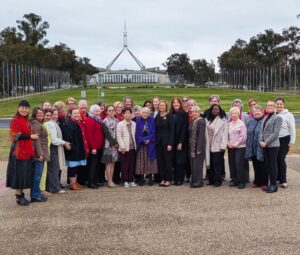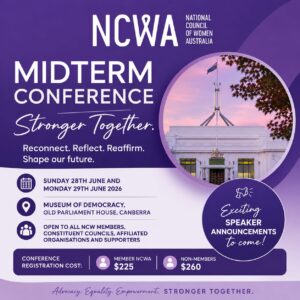
At the NCWA Midterm Conference on Sunday the 28th June 2026, NCWA RESOLVED to urge the Australian Government
Resolution One: Nationally standardised child protection and consent curriculum.
Work with all States and Territories to formalise and implement a standardised and mandatory Child Protection and Consent Curriculum in Australia.
Regularly review the content of the curriculum to avoid irrelevancy and missing relevant contemporary content. Rationale: Child protection education is one.
Resolution Two: Standardise laws across Australia to improve women’s and girl’s safety.
Standardise and harmonise laws to prevent and prosecute domestic, family and sexual violence including coercive control.
Work collaboratively to share information about those prosecuted for domestic, family and sexual violence offences across State Policing Entities.
Resolution Three: Equity in access to healthcare.
Develop a national approach to improve the promotion of and support to cover travel and accommodation costs that ensure people in rural and remote parts of Australia can access essential health services without undue burden;
This includes the need for a continual review of distance thresh holds;
Also there needs to be a simplified reimbursement process.
Resolution Four: Government assistance with installation of residential rainwater tanks.
Develop a national approach to subsidise the purchase of rainwater tanks for existing residential households.
Develop incentives to be offered initially on a joint basis by federal and state governments.
Develop a national policy of installation of rainwater tanks in all residential new builds where practicable. Ideally the subsidy should commence immediately (within 12 months).
Resolution Five: Elimination of Child Marriage in Australia.
Legislate to prohibit all forms of marriage under the age of 18 without exception across all Australian jurisdictions.
Remove all legal provisions permitting marriage under the age of 18, including exemptions involving parental or court consent.
Develop nationally consistent legislation, safeguarding measures, and enforcement responses relating to forced and child marriage.
Invest in prevention, early identification, education, and support services for individuals at risk of forced or child marriage.
Align Australian legislation and safeguarding systems with international human rights obligations, including Sustainable Development Goal 5.3 relating to the elimination of child marriage.
Resolution Six: National Framework for Technology-Facilitated Abuse.
Develop and implement a coordinated national framework to prevent and respond to technology-facilitated abuse.
Establish national coordination across justice, child protection, online safety, education, and AI governance systems.
Embed Safety by Design principles and prevention-focused approaches into digital technologies and platforms.
Strengthen legal responses to online grooming, image-based abuse, exploitation, AI-generated abuse material, and technology-facilitated coercive control.
Introduce nationally consistent data collection, reporting, and accountability mechanisms relating to technology-facilitated abuse.
Improve coordination between government, regulators, industry, and community organisations to support prevention and safeguarding responses.
Resolution Seven: Identify culturally sensitive, community-led approaches to locating and supporting child-headed households without inadvertently driving them underground.
Undertake a culturally responsive national inquiry into the prevalence, nature, and impacts of child-headed households within affected communities.
Engage in collaborative, community-led partnerships with trusted community leaders, child protection experts, faith leaders, women’s groups, and youth advocates to co-design effective responses.
Invest in culturally competent family strengthening programs that address underlying drivers, including financial stress, family violence, and the need for parenting support.
Establish and fund community-based supervision and mentorship initiatives to ensure vulnerable children and young people have access to safe, consistent adult guidance.
Strengthen dialogue and partnerships between police, schools and communities to address concerns regarding racial profiling, improve engagement, and rebuild trust in institutions.
Allocate dedicated funding for research and service implementation, including research to determine the scale, risks, and characteristics of child-headed households, and the development and delivery of targeted, culturally responsive intervention programs.
Resolution Eight: Advocacy Against ‘Placement Poverty’.
Advocates at a Federal level for student women at risk of ‘Placement Poverty’ and not completing their studies due to financial and mental health stresses created by compulsory work placement.
Support and encourage research into the impact of compulsory unpaid work placements and ‘Placement Poverty’, including through letters of support for funding applications and collaborative partnerships with relevant organisations and researchers, particularly in advance of the legislated 2027–28 review of the Commonwealth Prac Payment.
Prepare a submission to the 2027–28 legislated review of the Commonwealth Prac Payment, informed by current research and lived experience, advocating for equitable and inclusive support for students undertaking compulsory unpaid placements.
Resolution Nine: Climate Change and Environmental Framework for Gender-Responsive Advocacy.
Recognise the gendered impacts of climate change, including but not limited to the areas of health, housing, economic security, education, safety, food security, disaster resilience and community wellbeing;
Ensure women and girls are actively included in climate governance, resilience-building, adaptation planning and environmental decision-making processes; and
Develops appropriate frameworks to ensure climate justice.